By Investor's Report Card · November 20, 2026
"Annualized return" is the most common way to describe how an investment did. It's also easy to misread. Here's what it means and where it can mislead you.
The annualized return is the steady yearly rate that would have turned your starting amount into your ending amount. Real returns jump around from year to year; the annualized return smooths them into one rate you can compare with anything else, like an index or a savings account.
Suppose an investment gains 50% one year and loses 50% the next. The average of +50% and −50% is 0%, but you didn't break even: $10,000 became $15,000, then $7,500. You lost 25%, and the annualized return is about −13.4% a year.
Losses hurt more than equal gains help, so a bumpy ride ends lower than a smooth one with the same average. That's why the annualized return is the honest number.
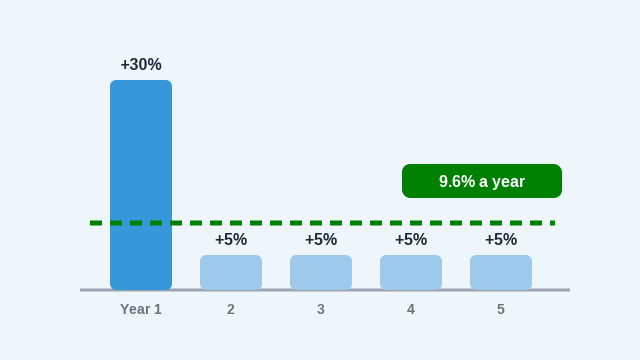
| Year | 1 | 2 | 3 | 4 | 5 |
|---|---|---|---|---|---|
| Return | +30% | +5% | +5% | +5% | +5% |
Over five years this works out to about 9.6% a year, which sounds strong. But four of the five years earned only 5%. Always ask for the yearly returns too, and look at the most recent years: they say more about how things are going now.
A 5% gain in three months annualizes to about 21.6% a year, a number no one should expect to keep earning. Treat annualized figures for periods under a year with care. Investor's Report Card doesn't grade an account until it has at least three months of history, and for periods under a year it compares total returns rather than annualized ones.
If you added or withdrew money, the annualized return that matters is the one that counts each deposit and withdrawal from its date: what your money actually earned. Investor's Report Card works it out that way for the life of the account, each year and the latest month, and puts it next to the same figure for the market.
Investor's Report Card turns the numbers on your monthly statements into a report card: your account's real return, after deposits and withdrawals, next to the market indexes you choose, graded A+ to F.
This article is general information, not investment advice. Investor's Report Card is not a registered investment advisor and doesn't recommend any investment. Past performance doesn't guarantee future results.