By Investor's Report Card · October 9, 2026
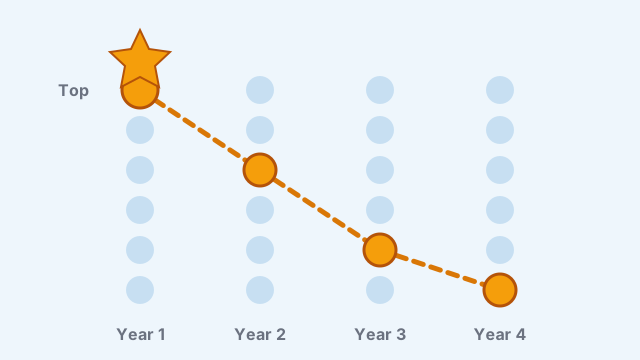
When a fund or a manager has a great year, it's natural to expect more of the same. The research says otherwise: top performance rarely lasts.
Twice a year, S&P Dow Jones Indices publishes its Persistence Scorecard. It takes the funds that ranked near the top of their category in one year and tracks whether they stayed near the top in the years that followed. If skill drove the results, the same funds should keep showing up.
top-quarter U.S. stock funds of 2021 stayed in the top quarter every year through 2025, apart from a few small-company funds.
of top-quarter large-company funds in 2023 were still in the top quarter two years later.
2025 was one of the better recent periods for persistence: of the large-company funds in the top half in 2023, 49% were still in the top half two years later. But over longer stretches the pattern returns. S&P concludes that outperformance, when it happens, "tends to be the result of luck rather than genuine skill."
A manager's one great year, or a fund's chart in an advertisement, says little about what comes next. What matters is how your own account has done against the market over many years, after every fee. Investor's Report Card shows exactly that, so you can judge your manager on the full record.
Investor's Report Card turns the numbers on your monthly statements into a report card: your account's real return, after deposits and withdrawals, next to the market indexes you choose, graded A+ to F.
This article is general information, not investment advice. Investor's Report Card is not a registered investment advisor and doesn't recommend any investment. Past performance doesn't guarantee future results.