By Investor's Report Card · October 30, 2026
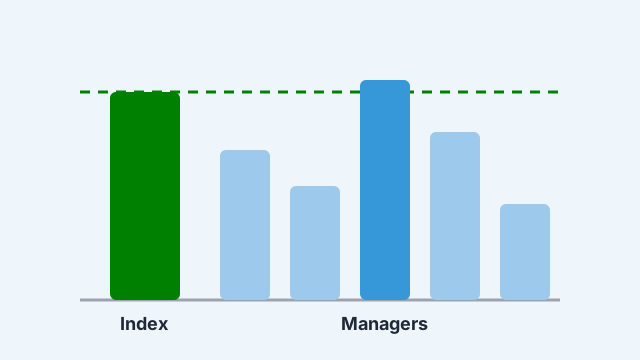
Most don't, especially over the long run. Decades of research comparing professionally managed funds with simple index funds point the same way: after fees, the index usually wins.
of actively managed U.S. large-company stock funds did worse than the S&P 500 in 2025.
did worse than the S&P 500 over the last 10 years.
did worse than the S&P 500 over the last 15 years.
Source: S&P Dow Jones Indices, SPIVA® U.S. Scorecard. 10- and 15-year figures as of June 30, 2026.
An index ETF (exchange-traded fund) simply owns every stock or bond in an index, such as the S&P 500, and trades like a stock. It doesn't try to pick winners, so it doesn't need a team of analysts.
What matters is the low-cost index approach, not the ETF itself. A low-cost index mutual fund does about as well.
These are the funds Investor's Report Card uses to stand in for each market index, plus a few other broad, low-cost index ETFs. They are examples to help you compare, not recommendations to buy.
| Ticker | What it tracks |
|---|---|
| SPY | S&P 500: 500 large U.S. companies (one of our comparison indexes) |
| DIA | Dow Jones Industrial Average: 30 large U.S. companies (comparison index) |
| ONEQ | NASDAQ Composite: stocks listed on the NASDAQ (comparison index) |
| IWM | Russell 2000: small U.S. companies (comparison index) |
| IWV | Russell 3000: nearly the whole U.S. stock market (comparison index) |
| URTH | MSCI World: large and mid-size companies in developed countries (comparison index) |
| AGG | U.S. investment-grade bonds (comparison index) |
| VOO, IVV | S&P 500, at a lower cost than SPY |
| VTI | The total U.S. stock market |
| VXUS | Stocks outside the U.S. |
| BND | The total U.S. investment-grade bond market |
Check each fund's current fees and holdings on its provider's website before investing. See how the comparison funds have done over the last 3 months to 4 years on Index returns.
These studies cover mutual funds. Advisors who manage individual accounts don't publish a scorecard, and a monthly statement doesn't tell you whether your account kept up with the market. That's the gap Investor's Report Card fills.
Investor's Report Card turns the numbers on your monthly statements into a report card: your account's real return, after deposits and withdrawals, next to the market indexes you choose, graded A+ to F.
This article is general information, not investment advice. Investor's Report Card is not a registered investment advisor and doesn't recommend any investment. Past performance doesn't guarantee future results.