By Investor's Report Card · November 13, 2026
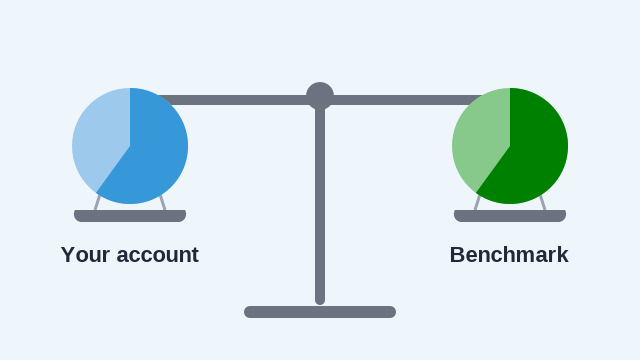
"Did my account beat the market?" depends on which market you mean. Compare a cautious, bond-heavy account with the S&P 500 and it will look bad in every strong year. Compare an all-stock account with bonds and it will look like genius. A fair benchmark matches how your money is actually invested.
Look at your statement's holdings, or ask your advisor, and sort them roughly into a few groups:
| Mostly in... | A fair comparison |
|---|---|
| Large U.S. companies | S&P 500, or the Dow |
| The whole U.S. stock market | Russell 3000 |
| Smaller U.S. companies | Russell 2000 |
| Technology and growth stocks | NASDAQ |
| Stocks around the world | MSCI World |
| Investment-grade bonds | U.S. bond index (AGG) |
Most managed accounts hold a mix of stocks and bonds. The fair comparison is a similar mix of indexes. If your account is about 60% stocks and 40% bonds, compare it with something close to 60% stock index and 40% bond index, not with stocks alone.
In Investor's Report Card you choose one to three different indexes for each portfolio, and the grade compares your account with their average. Some combinations:
Pick the benchmark before you look at the results, and keep it. It's tempting, for you or for an advisor, to choose whichever comparison looks best after the fact. If your advisor reports performance, ask which benchmark they use and why it fits your account.
If you move from mostly stocks to mostly bonds as retirement gets closer, update the benchmark too. A comparison that fit ten years ago may not fit today.
A fair benchmark includes the dividends and interest the index pays, just as your account does. A price-only index leaves those out and makes your account look better than it was. Investor's Report Card compares with index funds' adjusted prices, which include their dividends and interest.
Investor's Report Card turns the numbers on your monthly statements into a report card: your account's real return, after deposits and withdrawals, next to the market indexes you choose, graded A+ to F.
This article is general information, not investment advice. Investor's Report Card is not a registered investment advisor and doesn't recommend any investment. Past performance doesn't guarantee future results.