
By Investor's Report Card · November 12, 2026
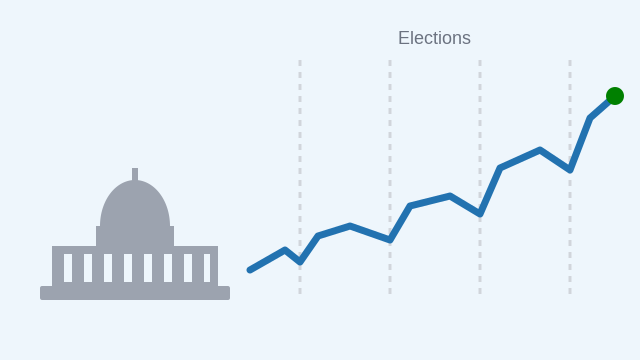
On November 3, Democrats won control of both the House and the Senate. The new Congress is seated on January 3, for the last two years of President Trump's term. If you're wondering whether your investments should change because of it, here is what history says, and what actually deserves your attention.
There's nearly 150 years of history on the stock market after midterm elections. Using Robert Shiller's long-run data, Motley Fool Research looked at the 12 months after each of 38 midterms from 1874 to 2022:
| After a midterm, the next 12 months | Average return | Times higher |
|---|---|---|
| All 38 midterms | 14% | 84% |
| Congress split from the president (23) | 16% | 91% |
| One party in charge of both (15) | 12% | 73% |
| Any 12 months since 1871, for comparison | 11% | 73% |
Fidelity reports a similar pattern for the S&P 500 since 1938: it rose in the 12 months after a midterm 95% of the time.
Those figures are encouraging, but they rest on a small number of examples: 23 and 15 elections, spread over wars, depressions, booms and very different economies. A few unusual years can move an average built on so few, and 6 of the 38 still ended lower. History says a change in Congress has not, by itself, been a reason for alarm. It doesn't say what the next 12 months will bring.
The day after this election, the Dow rose about 3%. That tells you about one day. Markets react to headlines, then go back to following earnings, interest rates and the economy. As one Fidelity strategist put it, elections are "a supplementary driver, not the core driver" of stock returns.
The costly mistake after an election isn't owning the wrong stocks for the new Congress. It's moving to cash and waiting for things to feel clearer. J.P. Morgan Asset Management found that missing just the 10 best days in the market over the past two decades would have cut a portfolio in half, and that the best days often come very close to the worst ones. People who step out after a scary drop tend to miss the rebound.
Elections come and go. What decides how you do over the years is how your account keeps up with the market and what you pay along the way. Investor's Report Card compares your account's actual return with the market indexes you choose, over the same months, so you can see how it's really doing, whoever is in charge.
Investor's Report Card turns the numbers on your monthly statements into a report card: your account's real return, after deposits and withdrawals, next to the market indexes you choose, graded A+ to F.
This article is general information, not investment advice. Investor's Report Card is not a registered investment advisor and doesn't recommend any investment. Past performance doesn't guarantee future results.