By Investor's Report Card · November 6, 2026
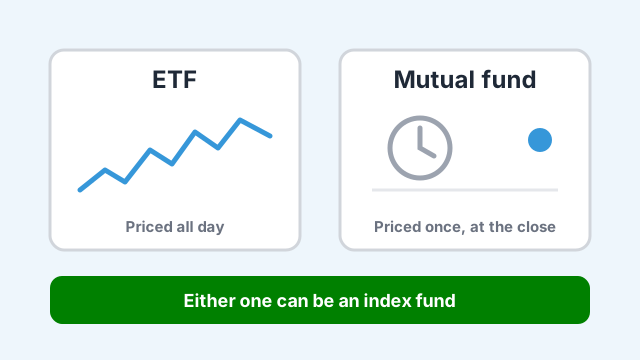
"Index fund," "ETF" and "mutual fund" get used as if they were three different things. They aren't quite. One describes what a fund invests in; the other two describe how you buy and sell it.
An index fund simply owns the stocks or bonds in a market index, such as the S&P 500, instead of a manager picking which ones to buy. Because it trades less and needs no stock pickers, it usually has lower costs, fewer taxable gains and lower fees than an actively managed fund. An index fund can be a mutual fund or an ETF.
| Mutual fund | ETF | |
|---|---|---|
| How you buy and sell | From the fund company | On a stock exchange, like a stock |
| Price | Once a day, at the closing value (NAV) | Changes all day at the market price |
| Minimum | Some require a minimum first investment | The price of one share (or less, where fractional shares are offered) |
| Taxes in a regular account | More likely to pay out capital gains | Usually fewer capital gains payouts |
The tax difference comes from how ETFs handle investors coming and going: many swap stocks in and out "in kind" instead of selling them for cash, so fewer gains are passed on to you. In an IRA or 401(k) the difference disappears, because you don't pay tax on gains inside those accounts each year.
For most long-term investors, what's inside the fund and what it costs matter far more than whether it's a mutual fund or an ETF. A low-cost index mutual fund and a low-cost index ETF that follow the same index will give very similar results. An actively managed fund, in either form, has to beat its index by more than its higher fees, and most don't.
Investor's Report Card uses index ETFs to stand in for the market: SPY for the S&P 500, DIA for the Dow, AGG for bonds and others. That way your account is compared with what you could have earned by simply owning the index.
Investor's Report Card turns the numbers on your monthly statements into a report card: your account's real return, after deposits and withdrawals, next to the market indexes you choose, graded A+ to F.
This article is general information, not investment advice. Investor's Report Card is not a registered investment advisor and doesn't recommend any investment. Past performance doesn't guarantee future results.